

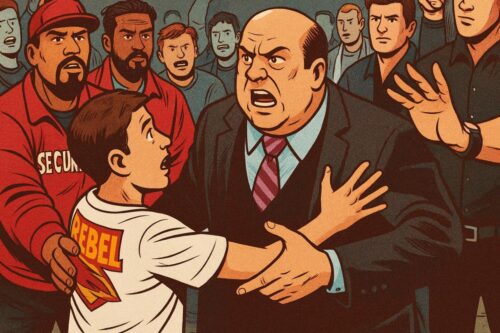
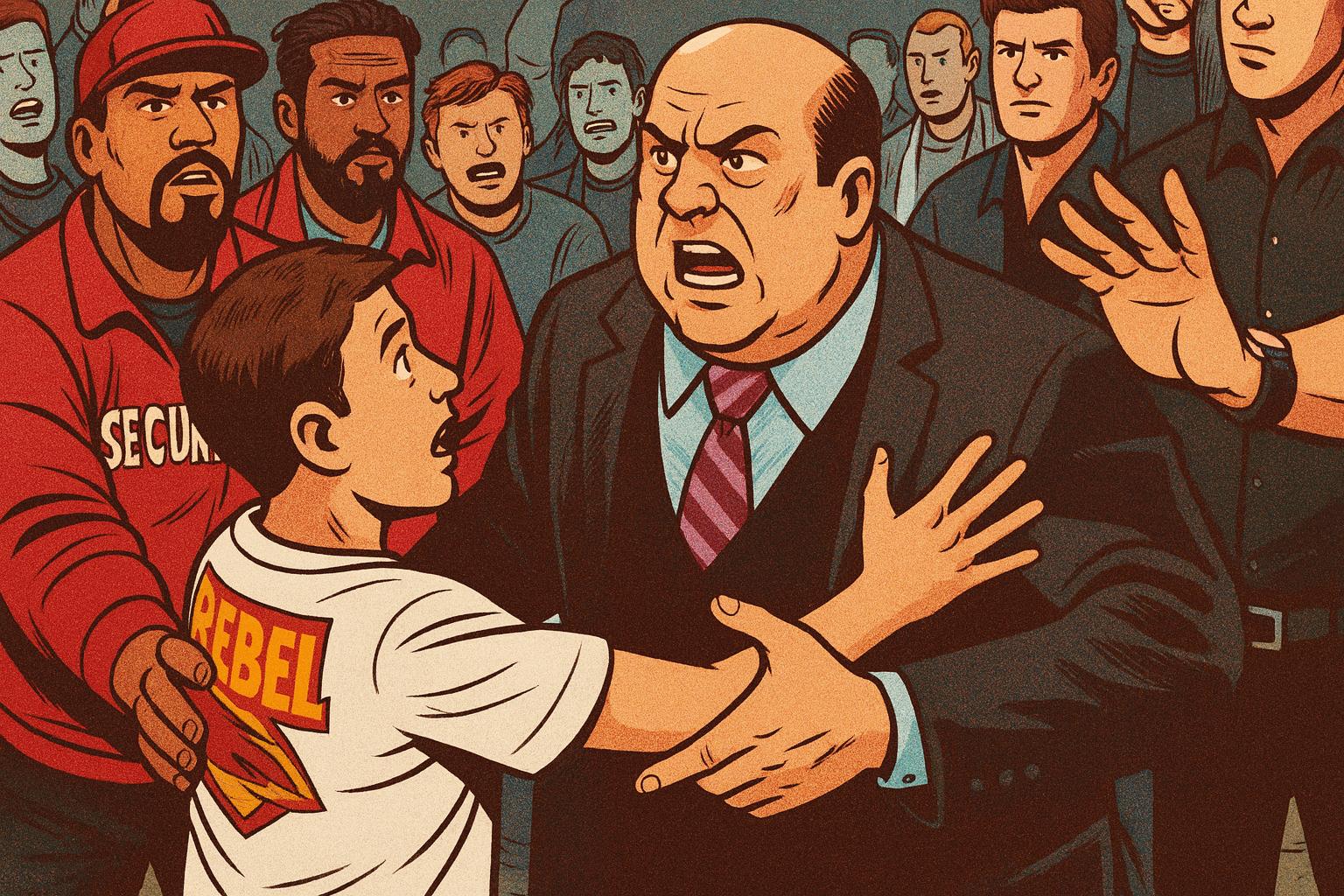
Kayfabe Isn’t Dead. A recent clip of Paul Heyman shoving a fan’s video has gone viral. But was it justified? This raises questions about boundaries in character portrayal.
In today’s social media era, it takes only a few seconds of video to create outrage.
A three-second clip is posted, context disappears, assumptions take over, and suddenly a man with decades of integrity is painted as a villain.
That’s precisely what happened with the recent clip of The Wiseman pushing a young fan backstage.
But the truth is simple: Paul Heyman did nothing wrong. In fact, his reaction was not only understandable — it was entirely justified.
Anyone who truly knows Paul Heyman’s body of work, his personality, his contributions, and his character would instantly recognize that the viral interpretation is wrong. This is not a man who mistreats fans.
The Hall of Famer is not someone who disrespects children. This is not an entitled celebrity acting out.
This is a man who has spent his entire life giving to this business, serving his fans, and giving to the world behind the character.
Paul Heyman is one of the most devoted fathers in the industry. The way he speaks about his children — with emotion, warmth, and pride — stands out in every interview.
He has always been generous, gentle, and compassionate with young fans.
Beyond that, Heyman has participated in countless Make-A-Wish moments with Brock Lesnar, Roman Reigns, and others, helping terminally ill children meet their heroes in ways that changed families’ lives forever.
Backstage after a major WWE event is chaos: narrow hallways, moving equipment, crew members, talent decompressing, and security directing traffic. The clip featuring Heyman makes clear that this is not a fan zone or photo-op area. This is a work environment, and only authorized people should ever be in the immediate path of talent.
He is the last person who would intentionally harm a kid. However, the situation that went viral had nothing to do with Heyman being heartless — it had everything to do with a fan stepping directly into his path in a restricted backstage area right after a physically and mentally exhausting pay-per-view event.
Moreover, what most people forget is that Paul Heyman wasn’t just “walking to the back.” He had just finished working the PPV both as an on-screen performer and as a backstage producer and creative mind — a stressful, high-adrenaline job that requires full emotional and professional engagement from start to finish.
On top of that, he had spent hours in a suit, coordinating talent, adjusting story beats, working with production, and then performing on camera. Naturally, Heyman was still coming down from that high-pressure state when the fan approached him.
This is where the real issue lies:
Security failed.
And, if you watch the footage closely, the security guard walking ahead of Heyman completely missed the approaching fan. So, whether it was inattention, laziness, or being overwhelmed, the guard allowed someone to walk directly into a performer’s path in a restricted area.
Security’s number one job is to protect the talent — not let them be approached, blocked, or placed in compromising situations. Heyman should never have been put in a situation where a fan could physically step in front of him. The job of creating a buffer belongs to security, not to Heyman.
Heyman’s reaction wasn’t aggressive or malicious — it was instinctive. Regardless of age, a stranger stepped directly into his space, and he moved the obstacle out of the way so he could continue forward. No shove with force, no yelling, or escalation. Just a natural human reaction while still processing the adrenaline of performance.
And there is another element casual fans miss entirely:
Paul Heyman is one of the last true believers in kayfabe.
Heyman is a genius in this business and understands the presence of cameras at all times. He knew the moment he walked backstage that cameras were rolling. He stayed in character — the “Wise Man” of The Bloodline, the top heel act in the company. What did people expect him to do? Break character, hug the kid, smile for a photo, and undermine the persona he just spent three hours portraying on global television?
Heyman is committed to the craft in a way most of the industry has abandoned. He reacted as Paul Heyman, the character, and Paul Heyman, the human being, protecting his space, not Paul Heyman the villain. The video of the encounter shows this commitment.
A deeper cultural problem within fandom — not just in wrestling but across entertainment as a whole — comes into focus. Somewhere along the line, a segment of fans developed the belief that buying a ticket, watching a show, or supporting a performer somehow entitles them to direct, guaranteed, and immediate access — free photographs, free autographs, and unlimited interaction at any time, in any place.
Boundaries matter. Respect is earned—safety to the fans and talent matter.
Approaching wrestlers in hallways, airports, bathrooms, or secure backstage zones is not passion — it’s entitlement.
Heyman did nothing inappropriate, and it’s a reminder to fans who get too close. He responded in the safest, most reasonable way possible under circumstances that should never have happened.
The fan shouldn’t have been there. Security should have stopped them. And Heyman shouldn’t be the one taking criticism for a situation he didn’t create.
Anyone who truly understands this business — or who understands Paul Heyman as a human being — can see the truth. This is a man who has given decades to the industry, changed lives, protected countless performers, and always respected the fans. He deserves the same respect in return.
In the end, Paul Heyman is not the problem.
The culture of entitlement is.
The failure of security is.
The lack of boundaries is.
Paul Heyman deserves understanding, not outrage.
Paul Heyman Didn’t Cross the Line. He Protected It.